
Important! Ensure that the Events you create align with the Centre Record names that you've uploaded! Otherwise, Centre Records will not appear on Recording Sheets
This Article Includes:
- Potential Event Records
- Centre Record Importing
- View and Manage
- Export and Purge
- An explanation of the fields/categories
- Edit your centre records
Potential Event Records
The potential Records report can be used to determine whether there are any entered results in ResultsHQ that have broken the Event Records list, based on Records current at that particular date.
For more information about potential records, please refer to our support article on Potential Records:
Centre Record Importing
For ResultsHQ to be able to display Centre Records on recording sheets, and also to be able to determine if a new Centre Record has been broken, you will need to import your current Centre Records into the system. To do this, follow the steps below.
1. Click on Meet Management and Select Event Records.
2. Click on Add / Import / Export and select Import Records.
3. You will reach the Event Record Import screen. Download the template, add the record details to the spreadsheet and then select the updated file to upload.
4. It is important that the same heading names are kept, as these are relied on during the import. For your convenience, we suggest sending your current Centre Records to support@timingsolutions.com.au and we shall get it started for you. A snapshot of the headings in the CSV file is below
| shortname | Record Value | createddatetime | membername | gender | agegroup | clubname | recordtype | recordperiod |
| 100m | 12 | 13-10-95 | Ryan D | M | 14 | Test LAC | Home | Current |
| Long Jump | 4.84 | 20-10-95 | O'Neill T | M | 14 | Test LAC | Home | Current |
| 1500m | 295 | 10-11-95 | O'Neill E | F | 14 | Test LAC | Home | Current |
| High Jump | 1.5 | 24-11-95 | Fisher J | F | 13 | Test LAC | Home | Current |
5. Save the exported template into a safe location on your computer
6. Enter the relevant details of the CRs that you would like to import; please take note of the various formats that are required in the bottom section of this help topic; ALL track times must be in total seconds e.g. if 800m and it is should be 3:08.21 then this would be 188.21
Note - the date needs to be in a date format.
7. Save the file.
8. Go back to the Event Record Import screen as follows:
9. Select Choose File and then navigate to and select the template that you have saved down with the appropriate Records on it
10. You will return to the Event Record Import screen, you will see the first part of the filename that you selected mentioned. Press the Preview button
11. At the bottom of the screen you will find a preview of the data that has been found in the template. If you are happy that it is the correct file, then re select the file via Choose file then press Upload Records to import the data
12. You will be presented with a screen which will tell you if there are any errors, and will indicate which rows / records there were errors with. You will need to re-upload the records with issues (Note: only upload those records, if you re-upload the entire template anything that was already uploaded will be duplicated.)
13. If the import keeps failing due to the date format being incorrect, please save your file as a csv and try reuploading.
Column Name Updates on the Event Record Screen
The columns on the Event Record screen have been renamed for clarity. When viewing records or reviewing import previews, the column headers now appear as:
- Location/Weight/Measure — previously labelled "Location". This column captures the configured event setting (location, weight, or measure) tied to the record.
- Free Text — previously labelled "Location Free Text". This column captures any free-text entry associated with the record.
These are label changes only — the underlying data and import behaviour remain the same, and existing templates do not need to be updated.
Important — Location, Weight, and Measure Setup If an event's location has not already been configured in ResultsHQ before importing, that field will not be imported against the Centre Record. Ensure all relevant event settings are fully set up prior to running a CSV import.
View and Manage
To view and manage the Event Records List at any time select Event Records under Meet Management.
This will open the Event Records List screen
Export and Purge
There is an option to Export and Purge your Centre Records. You may need to do this if you have managed to create duplicated CRs in your ResultsHQ profile. The feature will firstly create an export/CSV file of the Centre Records within your Centre Records list, and it will then DELETE, yes Delete you CRs - so use it with care!
At this stage, if you were to re-import the exported CSV, the CR list would be restored. However, CRs will not be 'attached' to specific Member IDs, despite their names being present against the records. So if you were to do this midseason, you would not be able to award points to the people that received the CRs during the season if you deleted them.
We are aiming to improve this functionality so that an Import will indeed attach a CR to an individual, however, it is not implemented yet. Please be in touch if you are looking to undertake this process as we can provide guidance support@TimingSolutions.com.au or raise a support ticket.
An explanation of the fields/categories
Short Name This represents the Event Name that the CR was achieved in. It is important that you use spelling that is exactly the same as the event name in the Event list
- Example 100m.
Record Value This is the result of the CR. It is import that the record value is in the correct Unit of Measure (see below field description). Note that at this stage track results must all be in seconds, with milliseconds separated by a fullstop (.). For field events, values must be in metres, with millimeters separated by a fullstop (.)
- Example For the 100m, a value might be 15.25. For the 800m, the record value might be 125.50 (which will convert to 2:05.50 mins)
Create Date/Time This is the date the result was recognised as a centre record. Must be in a standard date format such as dd/mm/yyyy.
Member Name This is the name of the member that was awarded a CR. Note: If you are importing CRs, these will not be 'attached' the member if they exist this season. You will not be able to allocate points based on these imported CRs.
- Example John Smith
Gender This represents the gender of the athlete who was awarded a CR.
- Example Female or Male
Age Group This is the age group that the CR was awarded within ie the age group of the athlete that was awarded the record, during that season
- Example To set up as an Under 7, enter 7
Club Name This is the club name of the athlete, or the Centre name for a single club organisation. Note: The value must be exactly the same as you have set up in the Centre/Club Setup step otherwise it will not be recognised by ResultsHQ
- Example The Pirates
Record Type Here you can set up specific Record types such as Home (standard), Away or Open records.
- Example Home or Away or Open
Record Period This indicates whether a CR is the 'current' record for that event, or whether it is a historical record which is simply kept here for historical reporting. Current records will be used by ResultsHQ to determine if new results that are entered have surpassed the CR.
- Example Current or Historical
Here's an example of what your centre records should look like as you upload them...
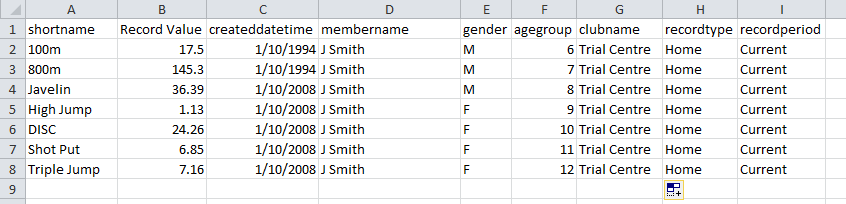
Note that the times are always recorded in total seconds rather than minutes, this is important for a smooth transfer.
Edit your centre records
If you need to edit/remove a centre record follow these steps:
1. Click on Meet Management and Select Event Records.
2. Select the relevant combination of age gender events to narrow down your screen
3. To delete the wrong record click on the Delete button, and then key in DELETE (in capitals) then press Submit
4. To edit a record, click on Edit button.
5. Edit the details you want and click Submit.
Comments
0 comments
Article is closed for comments.